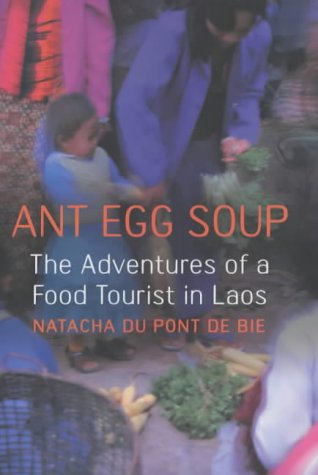
Ant Egg Soup: The Adventures Of A Food Tourist In Laos
 Customer Review: Couldn't find Ant Egg Soup! But....
Ant Egg Soup was the last book I read before departing for Laos after reading what few books I could find about Laotian history, customs and people. And it was the first book I read after returning. The writer captured the essence of the people, customs and food of Laos. Ant eggs were about the only food I wasn't able to find. As a Westerner, we are repulsed by the thought of eating insects and bugs. She inspired me to try a traditional Laotian dinner. Unbeknownst to me when I ordered it consisted of fermented fish, Mekong River algae crackers, fried tadpoles, rice paddy crabs, bee pupae in honeycomb, silk worm, grated dried water buffalo skin and dried water buffalo instestines to mention a few items. It all was amazingly good, as was all the other food to be found in Laos and Cambodia. Well done and a must read for anyone heading off to SE Asia.
Customer Review: You'll be able to taste the laap...
This is a beautiful book about Laos, its people, and their customs. The descriptions of the food are spot-on and the recipes are a great bonus. As a transplanted Lao-American trying to recreate flavors of my past, this was quite a gem of a find. If you have any interest in Southeast Asian culture or tourism, you definitely must read this. The parts about Luang Prabang and the Plain of Jars will have you googling airfare to Laos in no time.
Today, the consumption of Chinese tea is prevalent in most parts of the world. Chinese green tea is the more popular one in the Americas, though the consumption of white tea is increasing at a fast pace, especially after studies detailing its health benefits have been published. Who could have thought that the wild leaf discovered unintentionally more than 4000 years ago would become one of the most popular beverages of all time!
The discovery of Chinese tea is an interesting one. The story as it goes in China is that Emperor Shen Nung in 2737 B.C. went on a long trip. When he stopped to rest, a servant went to get him boiling water. From a wild tea bush, a dead leaf fell into the pot of boiling water. Unnoticed to the eyes of the servant, it was presented to the Emperor who drank it and found the drink to be very refreshing. And thus, tea was born!
Then, as time progressed, so did a transition take place in the production of Chinese tea. The earliest mention of widespread drinking of tea in China was during the Tang Dynasty (618-907 A.D.). Then Chinese tea was processed in a way which many would find unbelievable today. Tea leaves were plucked, dried and then compressed in the form of cakes. The tea leaves in this dried cake form were then ground in stone mortars. The powdered cakes were in boiled in earthenware vessels and consumed as a hot beverage.
About Chinese Tea
The processing of Chinese tea developed vastly in the seventeenth century. A process, known as fermentation was introduced. Though technically, this process was not fermentation, but rather an enzymatic oxidation of the tea leaves. This process could be manipulated to get the desired result by changing the rate of drying or steaming the leaves. In fact, in southern China, the leaves were sun dried and half fermented to produce Oolongs. Further development of Chinese tea led to the production of present day white tea in 1796 during the Qing Dynasty. Finally, mass export of Chinese tea started in 1891, with the export of the Silver Needle.
Today, tea is produced in over 40 countries and consumed in scores more. Yet, the flavors of this exquisite drink was unknown to the majority of the world till the late 19th Century when it started to be exported on a mass scale from its birthplace, China. Nearly, ninety percent of the worlds tea production comes from Asia and all the tea bushes around the world have their origins, either directly or indirectly, in China. Almost all the major tea producing nations have their own unique methods to process the tea leaves. Tea leaves which have been processed using methods practiced in Mainland China are known as Chinese tea.
For decades, the process of steaming was the primary method of preparation of Chinese tea. However, during the fourteenth century, the method of producing Chinese tea underwent another transition. The tea leaves were roasted and allowed to crumble, rather than being steamed. This was the origin of modern day loose teas. However, what prompted this change on a mass scale was a decree by the Ming court in 1391 that only loose tea was to be accepted as tribute.
posted by laurencia--17987 at 8:50 PM


1 Comments:
I love this book. The author takes you on a fabulous food journey through Laos and even if food isn't your thing this book will really whet your appetite for travel and adventure. I will need to read this again before I go to Cambodia in a few months to get ideas of what to ask for to try. Natasha has what I see as a truly wonderful vocation. Travelling to seek the traditional foods and hunting recipes. I hope one day to follow in her footsteps but doing it by pushbike, cycling through interesting pasts of the world and getting a real taste of how they live. I really wanted to eat ant egg soup & as Natasha gives recipies and supplier lists I hoped to buy the ingredients to try for myself ( cooking ant egg soup in Scotland ) but the ant eggs seem to now be difficult to get hold of. Maybe I can try it in Laos one day.Fingers crossed.
Post a Comment
<< Home